
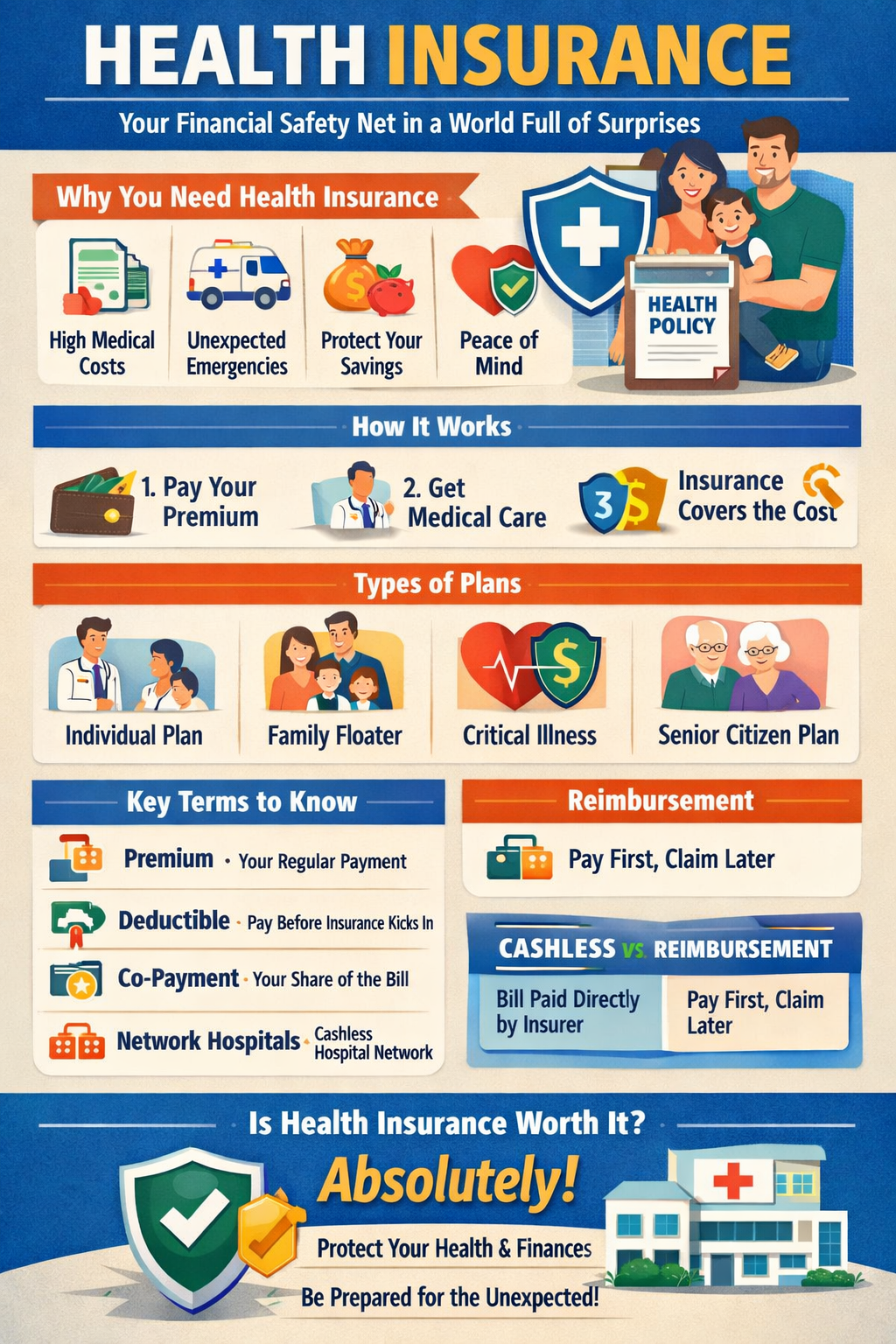
Health Insurance Your Financial Safety Net in a World Full of Surprises
Let’s be real for a second—life is unpredictable. One day you’re perfectly fine, and the next, you’re dealing with a medical emergency that drains your savings faster than you can say “hospital bill.” That’s exactly where health insurance steps in—like a financial bodyguard you didn’t know you desperately needed.
But what exactly is health insurance? And why does everyone keep talking about it like it’s a must-have? Let’s break it down in a simple, no-jargon way.
What Is Health Insurance, Really?
Think of health insurance as a backup plan for your health expenses. You pay a certain amount regularly (called a premium), and in return, the insurance company helps cover your medical costs when things go wrong.
It’s like subscribing to peace of mind.
Instead of paying huge hospital bills out of pocket, your insurance shares the load—or sometimes takes care of most of it.
Why Do You Even Need Health Insurance?
You might be thinking, “I’m healthy. Why bother?”
Fair question. But here’s the catch—health issues don’t send invitations.
A sudden accident, unexpected illness, or even a minor surgery can cost a fortune. Without insurance, you’re on your own financially. With it? You’ve got support.
Here’s why it matters:
- Medical costs are rising every year
- Emergencies can happen anytime
- Savings can vanish overnight
- Peace of mind is priceless
It’s not just about being sick—it’s about being prepared.
How Does Health Insurance Work?
Let’s simplify it:
- You choose a plan and pay a premium (monthly or yearly)
- If you need medical care, the insurer covers part or all of the cost
- Depending on your plan, you may pay a small portion (deductibles or co-pay)
It’s like splitting a bill—but your insurer picks up the bigger share.
Types of Health Insurance Plans
Not all plans are created equal. Picking the right one is like choosing the right pair of shoes—it has to fit your needs.
1. Individual Health Insurance
Perfect if you’re covering just yourself.
2. Family Floater Plan
One plan covers your entire family. Budget-friendly and convenient.
3. Critical Illness Insurance
Covers serious diseases like cancer or heart conditions with a lump sum payout.
4. Group Health Insurance
Provided by employers. Great, but often limited.
5. Senior Citizen Plans
Designed specifically for older adults with higher health risks.
Key Terms You Should Know (Without the Confusion)
Insurance can sound like a foreign language. Let’s decode it:
- Premium: The amount you pay regularly
- Sum Insured: The maximum amount your insurer will cover
- Deductible: The amount you pay before insurance kicks in
- Co-payment: A small portion you pay during a claim
- Network Hospitals: Hospitals where you can get cashless treatment
Once you understand these, you’re already ahead of most people.
Cashless vs Reimbursement: What’s the Difference?
Imagine this scenario—you rush to the hospital.
Cashless Treatment
No need to pay upfront. The insurance company settles the bill directly with the hospital.
Reimbursement
You pay first, then claim the amount later.
Cashless is smoother. Reimbursement works—but needs paperwork and patience.
How to Choose the Right Health Insurance Plan
Choosing health insurance isn’t about picking the cheapest option—it’s about picking the smartest one.
Ask yourself:
- What’s my budget?
- Do I need family coverage?
- What hospitals are nearby?
- What illnesses are covered?
Quick tips:
- Go for higher coverage (medical costs rise fast)
- Check hospital network
- Read the fine print (yes, really!)
- Compare multiple plans
It’s like dating—you don’t commit without knowing what you’re getting into.
Common Mistakes People Make
Let’s save you from some costly errors:
- Buying insurance too late
- Ignoring policy details
- Choosing low coverage to save money
- Not renewing on time
- Assuming “it won’t happen to me”
That last one? Probably the most dangerous.
Benefits of Having Health Insurance
Still on the fence? Here’s what you gain:
- Financial protection during emergencies
- Access to better healthcare facilities
- Tax benefits (yes, you save money too!)
- Stress-free treatment without worrying about bills
It’s not just insurance—it’s security, confidence, and control.
Health Insurance Myths—Busted!
Let’s clear the air:
❌ “I’m young, I don’t need it.”
✔ Accidents don’t check your age.
❌ “It’s too expensive.”
✔ Hospital bills are far more expensive.
❌ “My company covers me.”
✔ What happens if you change jobs?
Don’t let myths cost you real money.
Conclusion: Is Health Insurance Worth It? Absolutely.
At the end of the day, health insurance is like a seatbelt—you hope you never need it, but you’ll be glad it’s there when you do.
Life throws curveballs. Some are small, others can shake your entire financial foundation. Health insurance ensures that a medical emergency doesn’t turn into a financial disaster.
So, the real question isn’t “Should I get health insurance?”
It’s—“Can I afford not to?”
Take the step today. Your future self will thank you.